Watch Schemes
There is a lot to be said about watch schemes and time management. The IPRCS requirement for a sharp lookout at all times also holds on ocean journeys, so we need to find ways to ensure we have a constant lookout. On the larger ships, with larger crews, the naval routine typically is:
"Ship’s Bell Time"
- First Watch, 8pm to Midnight (20:00 to 00:00 hours)
- Middle Watch, Midnight to 4am (00:00 to 04:00 hours)
- Morning Watch, 4am to 8am (04:00 to 08:00 hours)
- Forenoon Watch, 8am to Noon (08:00 to 12:00 hours)
- Afternoon Watch, Noon to 4pm (12:00 to 16:00 hours)
- First Dog Watch, 4pm to 6pm (16:00 to 18:00 hours)
- Second Dog Watch, 6pm to 8 pm (18:00 to 20:00 hours)
The dog watches have two general advantages: they allow all crew to eat at ‘normal’ dinner time, and they change the timing of the watch for each team, ensuring everybody has duty in different periods per day and night along the journey.
On smaller vessels, one may consider other schemes. Some general considerations are:
- Leave the skipper out of the equation.
- Allow for enough time for daily routines, cooking, cleaning, maintenance, and (celestial) navigation.
- Ensure everybody gets enough rest and sleep.
- Differentiate between Rest, On-Call, and Watch shifts.
- Duties of watchkeepers.
- Night watches are more tiring than day shifts.
- Dinner. i.e., the warm meal, could well be served around noon or at 13:00 hours.
- Climatic conditions.
- Flexibility (f.i, in case of an ‘uneven’ spread of the exposure to the elements).
- Single-person or multiple-person watches.
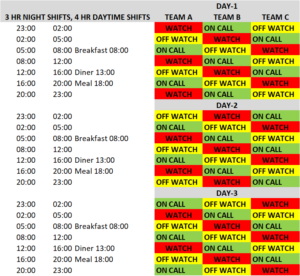
An example of a scheme that generally works is:
Time Management
Daytime periods typically change along an ocean passage, especially on E-W passages. A generally accepted practice is to adjust the board time to the associated time zone of your longitude position, ensuring the crew experiences the usual ‘daytime’.
It is a matter of choice to synchronize your watch scheme to follow board time or f.i. UT time. Whatever you decide, do not make it too complicated and use only one ‘clock’ system.